
our approach
What follows is how we think about financial planning — and why the approach that works at thirty-five is not the same approach that works at sixty-five. The specific application depends on where you are in your financial life, which is why each life stage has its own dedicated page.
YOUR MOST VALUABLE FINANCIAL ASSET PROBABLY DOESN'T APPEAR ON ANY BROKERAGE STATEMENT.
It’s your Human Capital — the present value of everything your skills, education, experience, career, and your personal and professional networks will generate over your working lifetime. For most people in their thirties and forties, Human Capital is by far the largest component of their total wealth. It dwarfs the portfolio.
Understanding this changes how we think about financial planning — at every stage.
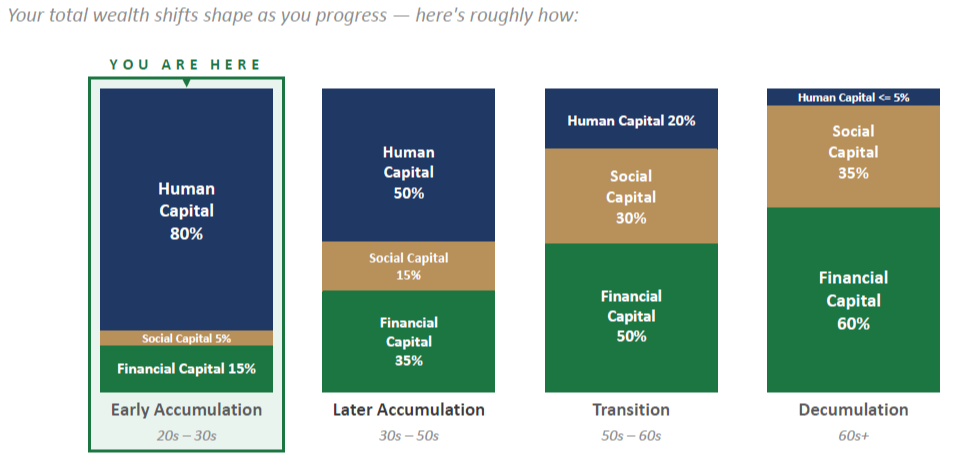
We organize a household’s total wealth into three components:
Human Capital
Human Capital is the engine of the accumulation years. It is the source from which Financial Capital is built — every paycheck, every savings contribution, every investment is a conversion of Human Capital into a more durable form of wealth. Human Capital is also, in an important sense, a bond-like asset: it generates relatively stable, inflation-sensitive income over time. This has a direct implication for how the financial portfolio should be constructed during the accumulation years — because if Human Capital is already functioning as implicit fixed income, and burgeoning Social Capital is doing the same, the financial portfolio doesn’t need to hold much of it. It can lean heavily toward growth assets.
Social Capital
Social Capital provides the retirement income floor. Social Security, pensions, and lifetime income annuities are forms of Social Capital — pooled, guaranteed, and in many cases inflation-adjusted. They cannot be outlived. They form the foundation on which everything else in retirement rests, which is why optimizing Social Security claiming decisions is among the highest-value work we do with clients approaching retirement.
Financial Capital
Financial Capital is the accumulated portfolio — savings accounts, investment accounts, retirement accounts, real estate, and other financial assets, reduced by liabilities. Financial Capital starts small, grows steadily through the accumulation years as Human Capital is systematically converted into it, and is then drawn down in retirement to supplement Social Capital and fund the life that was planned for.
What makes this framework powerful is what it reveals about how the proportions shift. Early in a career, Human Capital dominates. By the time of retirement, Human Capital has been largely converted — into Financial Capital and, through payroll taxes and savings, into Social Capital. The financial portfolio that was appropriate at thirty-five is not appropriate at sixty-five, and the reason is not just that the client is older. It’s that the composition of their total capital has fundamentally changed and the role for a complementary financial portfolio has changed along with it.
MOST FINANCIAL PLANNING STARTS WITH THE QUESTION: WHAT DO I HAVE? WE ADD A SECOND QUESTION: WHAT WILL I NEED?
For accumulation clients, the gap between those two questions is measured in decades. The planning work is primarily behavioral and structural — building the right habits, automating the right behaviors, constructing a portfolio that will compound effectively over time. The future liabilities are real, but they’re too distant to plan against with precision.
For clients approaching retirement, that gap closes rapidly — and a new set of risks emerges that accumulation-style thinking is not equipped to handle.
Researchers who study retirement income planning have identified what they call the Fragile Decade — roughly the five years immediately before retirement and the five years immediately after it. During this window, the sequence in which investment returns occur matters as much as the average return itself. A significant market decline early in retirement, when a client is simultaneously beginning to draw from the portfolio, can permanently impair the plan in ways that the same decline five years earlier would not. This is Sequence of Returns Risk, and it is the organizing danger of the transition into retirement.
The appropriate response is a fundamental shift in how the portfolio is organized. Rather than asking “how do I maximize long-term growth?” we begin asking “how do I structure what I have so that my essential spending needs are funded reliably, regardless of what markets do?” This is the principle behind Liability-Driven Investing — planning from the liability side, not just the asset side.
In practice, at Epsilon, this means identifying essential spending needs and funding them with the most reliable, inflation-protected sources available: Social Capital first, supplemented by Treasury Inflation-Protected Securities and other fixed income instruments with guaranteed characteristics. Discretionary spending and long-horizon growth goals are funded from the remainder of the portfolio, which can maintain meaningful equity exposure because cash flow from it is not needed immediately and it can absorb short-term volatility.
This structure — aligning capital sources to spending needs — does several things simultaneously. It protects essential spending from market volatility. It reduces the overall exposure to Sequence of Returns Risk. It preserves the growth potential of the long-horizon portion of the portfolio. And it gives clients a clear, intuitive picture of where their income comes from and what it is designed to fund.
Financial planning is a process, not a document. It is built in a specific sequence because each step depends on the one before it.
Here is the sequence we follow — most completely for clients in the Transition stage, in adapted and shortened form for our Accumulation and Decumulation clients:
STEP 1 STATEMENT OF FINANCIAL PURPOSE
We begin with values, not numbers. What matters most to you? What is this money actually for? What does financial independence mean in your life, and what does an ideal version of the future look like? The answers to these questions are the inputs that give every subsequent step its direction. A technically perfect financial plan that funds the wrong retirement is not a good plan.
STEP 2 PERSONAL BALANCE SHEET
A complete picture of what you own and what you owe, organized clearly and updated regularly. Net worth — the single most motivating number in personal finance, and one that is entirely within your control to improve.
STEP 3 SPENDING CLASSIFICATION
We distinguish essential spending — the non-negotiable costs of the life you intend to live, for as long as you live it — from lifestyle spending that is meaningful but discretionary, and from legacy and bequest goals. This classification is foundational to the retirement income structure and to every asset allocation and risk management decision that follows.
STEP 4 CASH FLOW ANALYSIS AND BASE-CASE MODEL
A clear view of income sources, spending patterns, and how both are likely to evolve. Not a thirty-year projection built on assumptions you can’t control, but a structural framework for understanding where the important decisions live and what the key transition points look like. This base-case model is the analytical foundation on which the steps that follow are built — every risk identified, every opportunity evaluated, and every portfolio decision made draws from this picture of where you stand and where you are headed.
STEP 5 RETIREMENT RISKS ANALYSIS
Before we can build a plan designed to protect you, we need to understand what you most need protection from. We conduct a systematic analysis of the retirement risks specific to your situation — assessing each for probability, severity, and the degree to which it can be mitigated by planning, insurance, or portfolio design.
The risks we evaluate include:
- Sequence of Returns Risk and its interaction with your planned retirement date
- Increased inflation and its particular severity for healthcare costs over a long retirement
- Long-term care events and the financial consequence of sustained care needs that Medicare does not cover
- Longevity and the compounding cost of planning too conservatively
- Lifetime income tax rate risk from legislative changes, RMD onset, or loss of filing status
- The Widow’s Tax – the income tax consequences of filing as a single individual after the death of a spouse
- The possibility of forced or unplanned early retirement due to health, layoff, or caregiving.
- Short-sighted Social Security and Medicare decisions — poorly timed or uninformed choices that are largely irreversible once made and that can cost six figures or more over a retirement lifetime
- Suboptimal investor behavior — the tendency to react emotionally to market events in ways that compound against the client over decades.
Not every risk is equally material for every client. The output of this analysis is a prioritized picture — specific to your assets, your income, your health circumstances, and your goals — of which risks pose the greatest threat to your plan and which are most addressable. This picture directly informs Steps 9 and 10.
STEP 6 LIFETIME INCOME TAX LANDSCAPE
We map your expected tax situation across the full arc of your financial life — not just this year, but across retirement, the transition to Social Security and Required Minimum Distributions, and in the event that one spouse predeceases the other. This landscape informs asset location, Roth conversion timing, withdrawal sequencing, and charitable giving strategy. The goal is to minimize the total tax cost across your lifetime, not just in any single year.
STEP 7 LIFE CYCLE CAPITAL DISPLAY
We visualize your total capital across all three forms — Human, Social, and Financial — and show how the proportions are shifting. This picture makes clear why the portfolio needs to change as retirement approaches, and in what direction. For Transition clients in particular, seeing the Human Capital decline and the Social Capital begin to rise is one of the most clarifying moments in the planning process.
STEP 8 HOUSEHOLD BALANCE SHEET
Building on the work above, we construct a Household Balance Sheet that treats your future spending needs as liabilities — the same framework a pension fund uses to manage its obligations. Assets are aligned to spending categories. The structure reveals what a traditional balance sheet cannot: whether your resources are genuinely sufficient to fund the retirement you have described, and where the gaps or surpluses lie.
STEP 9 RETIREMENT READINESS ANALYSIS
From the Household Balance Sheet, we derive a set of ratios that answer the retirement readiness question quantitatively. How do your total assets compare to the present value of your total spending needs? How much of your essential spending is covered by secure lifetime income sources? What does your projected wealth look like at the end of the plan under a range of scenarios? These numbers tell us whether you are on track, ahead, behind, or in a range that requires adjustment — and they give us a specific, quantitative target for the portfolio construction that follows.
STEP 10 PORTFOLIO CONSTRUCTION, ASSET LOCATION, AND RISK MITIGATION
With the full analytical work complete — the retirement readiness ratios, the lifetime tax landscape, the Life Cycle Capital picture, and critically, the retirement risks analysis from Step 5 — we construct or restructure the portfolio. This step has three interlocking objectives.
The first is alignment: matching capital sources to spending needs, as described in the Liability-Driven Investing section above. Social Capital and fixed income Financial Capital fund essential spending. Taxable accounts fund lifestyle spending and reserves. Roth and taxable accounts fund long-horizon growth and legacy goals.
The second is risk mitigation: the portfolio is specifically designed to address the highest-priority risks identified in the retirement risks analysis. Sequence of Returns Risk is addressed structurally first — by funding essential spending from Social Capital and fixed income sources that do not depend on portfolio performance, we remove essential spending from the market’s reach entirely during the most vulnerable window. The remaining portfolio, not needed immediately, can absorb short-term volatility without consequence to the plan.
Inflation poses a related but distinct threat. A retiree living primarily on fixed income sources for twenty or thirty years will see the purchasing power of those sources erode over time — and healthcare inflation, in particular, has historically outpaced general price increases by a meaningful margin. Most retirees with moderate wealth need some form of inflation protection built into the income structure.Treasury Inflation-Protected Securities address this directly: their principal adjusts with actual realized inflation rather than expected inflation, providing protection against the unanticipated price increases that fixed income alone cannot hedge.
For clients where long-term care represents a material uninsured risk — which, given Medicare’s limited coverage of sustained care, describes most retirees — a dedicated spending reserve or an insurance solution is incorporated into the structure. The right answer depends on health circumstances, assets, and preferences, and is evaluated explicitly as part of the retirement risks analysis.
For clients with significant pre-tax account balances, a systematic Roth conversion strategy addresses future tax rate risk — reducing the pre-tax balance subject to Required Minimum Distributions, lowering future ordinary income, and building a tax-free reserve that is resilient to legislative changes in tax rates.The third is tax efficiency: account type is matched deliberately to the nature of the assets held within it and the spending category it is designed to fund. Tax-deferred accounts, Roth accounts, and taxable accounts each have different implications for current and future taxation. Getting asset location right — and maintaining it through ongoing rebalancing and deliberate withdrawal sequencing — compounds the benefit of the plan over time.
WE BELIEVE IN THE EFFICIENCY OF MARKETS - AND IN BUILDING PORTFOLIOS DESIGNED TO CAPTURE THAT EFFICIENCY RATHER THAN ATTEMPT TO DEFEAT IT.
The evidence on this point is substantial and consistent: investment strategies that rely on market timing, sector rotation, tactical allocation, or individual security selection do not, as a general matter, produce returns that justify their costs over time. Explicit management fees and implicit trading costs together erode whatever advantage active strategies might occasionally deliver. We don’t pursue outperformance through these approaches. We pursue efficient capture of market returns — at the lowest possible cost, with the highest possible tax efficiency.
Within that framework, we do believe in a disciplined application of factor tilts — deliberate, systematic exposures to characteristics that the research has demonstrated carry persistent return premiums. A modest tilt toward smaller companies, companies with lower relative valuations, and companies with stronger profitability has delivered higher returns across multiple markets, multiple time periods, and multiple economic environments. We hold this view not simply because the data shows these premiums exist, but because we believe there is a fundamental, durable reason for their existence: they reflect genuine differences in risk and the compensation that rational markets require for bearing that risk — or, in some cases, behavioral tendencies that prove remarkably persistent even when they are widely known. Notably, even the academics who developed the theory of efficient markets acknowledge the presence of such factors — describing them not as evidence that markets are wrong, but as features of how capital markets price risk. We incorporate these tilts where the evidence is strongest and where the cost of doing so is low.
We acknowledge that factor premiums present themselves inconsistently through time — there are extended periods when any given factor underperforms its benchmark. This is not a flaw in the thesis; it is precisely what makes the premium available to patient investors with long time horizons. Short-term inconsistency is the cost of long-term excess return. Our clients’ portfolios are constructed to capture these premiums systematically, at low cost, and with the patience to hold through the inevitable periods when they are not rewarding.
Tax efficiency is not an afterthought — it is a structural feature of portfolio construction from the outset. We use tax-advantaged accounts deliberately, manage capital gains thoughtfully, and maintain asset location across taxable, pre-tax, and Roth accounts as a core ongoing discipline. For accumulation clients, this means building tax diversification from the beginning — particularly through Roth accounts, whose long time horizon maximizes the benefit of tax-free compounding. For Transition and Decumulation clients, it means managing the drawdown sequence to minimize lifetime tax cost.
We use the RISA — Retirement Income Style Awareness — as a structured assessment to understand each client’s specific preferences for how essential spending needs are funded in retirement. Not every client wants the same income structure. The RISA identifies where on the spectrum a client falls — from those who want guaranteed income sources to cover all essential spending to those who are comfortable with a degree of market exposure — and informs how the portfolio is designed accordingly.
